Understanding credit spreads in theory is one thing. Seeing how they work in real trades — with real numbers, real risk, and real outcomes — is what actually builds confidence.
In this guide, I’ll walk through two practical SPX credit spread examples: a bull put spread for mildly bullish conditions and a bear call spread for mildly bearish setups. You’ll see exactly how I calculate max profit, max loss, breakevens, and probability before placing a trade — and why structure matters more than prediction.
These examples show how different types of credit spreads behave in live markets, how risk stays defined, and where beginners often go wrong with sizing or timing. If you want to understand how credit spreads really work — not just what they are — these examples will give you a clear, repeatable framework you can apply to your own trading.
<divIf you’re brand new to spreads, start with the basics:
What Is a Credit Spread?
or check my step-by-step guide
Credit Spread Strategy: When and How to Use It.
Trader’s insight: I trade SPX credit spreads weekly because they offer consistency and predictability. When you understand the math, you don’t need to guess the market — you just need to manage probability.
Example 1: SPX Bull Put Credit Spread (Mildly Bullish)
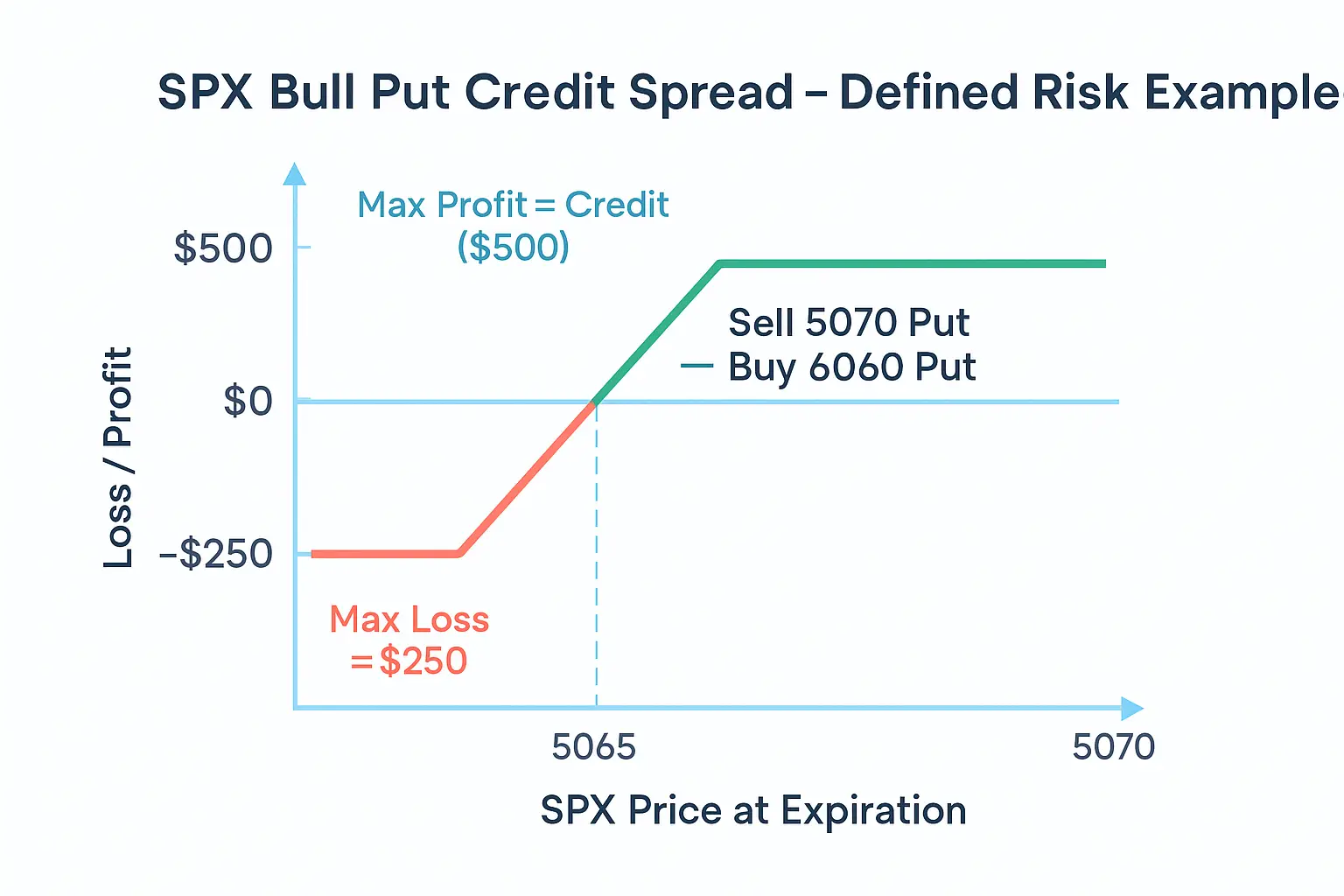
A bull put spread is a bullish credit spread where you sell a put option closer to the current price and buy another put further out of the money for protection. You earn a credit upfront and profit if SPX stays above your short strike at expiration.
Trade Setup
- Underlying: SPX
- Current Price: 5000
- Sell: 5070 put
- Buy: 5060 put
- Width: 10 points
- Credit Received: $5.00
- Days to Expiration: 30 (typical for Monthly Trend setups)
Trade Metrics
- Max Profit: $5.00 × 100 = $500 (credit received)
- Max Loss: (10 − 5) × 100 = $500
- Breakeven: 5070 − 5 = 5065
- Probability of Profit: around 60–70%
This is my go-to setup when I expect SPX to stay above support or drift higher. With a 5-point credit on a 10-point spread, the risk-to-reward ratio is roughly 1:1. This is a probability-based strategy. Most months, SPX won’t break below your short strike.
Tip: I usually close my bull put spreads at 50% of the max loss. That improves my risk-to-reward ratio to 1:2 while having a 60-70% win rate.
Example 2: SPX Bear Call Credit Spread (Mildly Bearish)
A bear call spread is the mirror image of a bull put spread. It’s a bearish credit spread where you sell a call near resistance and buy another call further out of the money to define risk. You profit if SPX stays below your short call by expiration.
Trade Setup
- Underlying: SPX
- Current Price: 5000
- Sell: 4960 call
- Buy: 4970 call
- Width: 10 points
- Credit Received: $5.00
- Days to Expiration: 30
Trade Metrics
- Max Profit: $5.00 × 100 = $500 (credit received)
- Max Loss: (10 − 5.00) × 100 = $500
- Breakeven: 4960 + 5.00 = 4965
- Probability of Profit: about 60–70%
This trade benefits from time decay and resistance levels holding. If SPX consolidates or drifts lower, the short call decays quickly, allowing you to buy it back cheaper. The long call protects you if SPX unexpectedly rallies.
Note: I avoid holding bear call spreads through major news events (like CPI or FOMC). Volatility can spike, widening spreads and distorting P&L.
Credit Spread Calculator: Understanding Risk and Reward
Every credit spread can be broken down into three key components: credit received, spread width, and breakeven point. Understanding how these elements interact helps you estimate risk and profit potential before placing a trade.
Formulas:
- Max Profit: Credit received × 100
- Max Loss: (Spread width − credit) × 100
- Breakeven: Short strike ± credit (minus for puts, plus for calls)
Let’s use the SPX bull put spread from earlier as an example:
- Sell: 5070 put
- Buy: 5060 put
- Credit: $5.00
Max Profit = $500, Max Loss = $500, Breakeven = 5065.
If SPX expires above 5070, you keep the full credit. If it falls below 5060, you lose the maximum.
That’s why we call this a defined-risk trade — there are no surprises at expiration.
Pro tip: Before entering a trade, always check your broker’s margin requirement.
Many brokers will reserve the full spread width (minus the credit), even though your loss is capped.
Common Mistakes Traders Make With Credit Spreads
Even though credit spreads are safer than naked options, traders still make predictable mistakes that hurt results. These errors usually come from misunderstanding volatility, sizing, or timing.
- 1. Selling too far out of the money: lower credit means higher risk if being wrong.
- 2. Ignoring volatility shifts: selling spreads during low IV can offer little reward for the risk taken.
- 3. Holding to expiration: trying to squeeze out the last few dollars increases gamma risk dramatically in the last 7 days before expiration.
- 4. Oversizing trades: even defined risk can hurt if you over-leverage your account.
- 5. Trading during major news events: CPI, FOMC, or NFP can move SPX 50+ points overnight — beyond your strikes.
Rule of thumb: trade smaller, close earlier, and avoid entering spreads through volatility events.
The goal is consistency — not perfection.
FAQs: Credit Spread Examples
How much can you make on a credit spread?
Your maximum profit is capped at the net credit received. On a 10-point SPX spread sold for $5.00, the most you can make is $500 per contract. Profit is realised when both options expire out of the money — or when you buy the spread back at a lower price before expiration.
What is the max loss on a credit spread?
Max loss equals the spread width minus the credit received, multiplied by 100. On a 10-point spread sold for $5.00, the max loss is $500: (10 − 5) × 100. This loss is realised only if the underlying closes beyond your long strike at expiration — both legs expire fully in the money.
What is the breakeven on a credit spread?
For a bull put spread, breakeven is the short put strike minus the credit received. For a bear call spread, it is the short call strike plus the credit received. In the SPX bull put example above — short 5070 put, $5.00 credit — the breakeven is 5065. Above that price at expiration, the trade is profitable.
When is the best time to enter a credit spread?
The best time to enter a credit spread is when implied volatility is elevated relative to its recent range, giving you a larger premium for the same strikes. Avoid entering within 24–48 hours of major macro events like CPI, FOMC, or NFP — a single print can move SPX 50+ points and blow through your short strike overnight.
What is the difference between a bull put spread and a bear call spread?
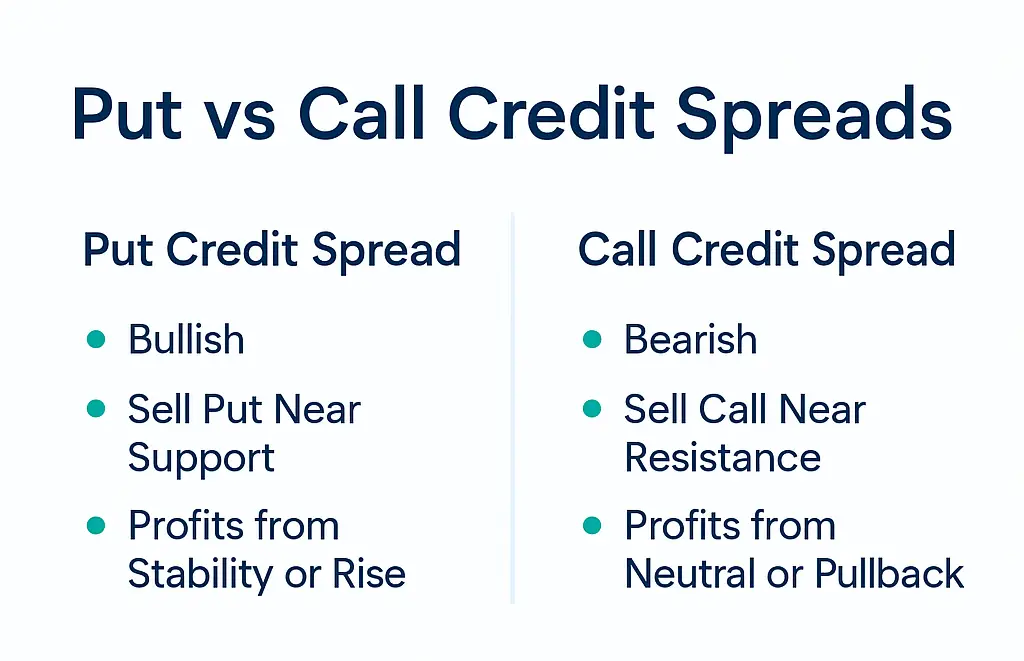
A bull put spread uses put options and profits when the underlying stays above your short put strike — it is a bullish or neutral strategy. A bear call spread uses call options and profits when the underlying stays below your short call strike — it is a bearish or neutral strategy. Both are credit spreads with capped risk and capped profit.
Should you let a credit spread expire or close it early?
Closing early at 50–60% of max profit is generally safer than holding to expiration. In the final 7 days, gamma risk accelerates — small moves in the underlying create outsized swings in the spread’s value. Closing early locks in most of the profit while eliminating the risk of a last-minute move against your position.
Conclusion: Turning Credit Spread Theory Into Practice
Credit spreads are one of the most efficient ways to trade defined risk. They allow you to generate consistent income without guessing direction, as long as you respect volatility and position sizing.
Whether you use a bull put spread or a bear call spread, the key is matching your setup to the market. Sell puts when the market looks stable or bullish, and sell calls when price stalls or reverses near resistance. Each trade has a purpose — it’s never random.
After 20 years of trading SPX options, I’ve learned that predictable income comes from structure, not prediction. Credit spreads deliver exactly that — structure, control, and consistency.
Master Credit Spreads: Complete Learning Path
To dive deeper into how I automate these setups weekly on SPX and SPY, explore the service below:
Automate Your Credit Spread Trading
Our Bull Put Credit Spread Signals system executes SPX trades automatically, following the same defined-risk rules outlined in this guide. Consistency — without emotion.