SPX and SPY both track the S&P 500, but when it comes to max pain, they behave very differently, and that difference matters if you trade options into expiration.
Many traders treat SPX and SPY max pain as interchangeable. In practice, they aren’t. Settlement mechanics, dealer hedging flows, and the mix of institutional versus retail participation all change how reliably price responds to max pain levels.
On SPX, those forces often create cleaner, more predictable expiration behaviour. On SPY, they introduce noise, overshoots, and late-day volatility that can distort the signal.
If you’re using max pain to guide strike placement for credit spreads or iron condors, choosing the wrong reference can lead to tighter margins and unnecessary risk.
Quick Answer
Is SPX or SPY max pain more reliable?
SPX max pain is more reliable than SPY max pain. Because SPX options are cash-settled, dealer hedging flows are cleaner and more predictable, and institutional participation dominates the order book. This creates a stronger gravitational pull toward heavy open-interest strikes near expiration — the effect traders call options pinning.
SPY is share-settled, heavily influenced by retail flow and ETF mechanics, and typically overshoots or ignores max pain levels. SPX max pain is a meaningful expiration reference for credit spreads and iron condors. SPY max pain is better treated as a soft zone of interest, not a precise target.
In this article, I break down how max pain actually works on SPX versus SPY, why professionals prioritise one over the other, and how to use each correctly in real trading.
What Is Max Pain (In Plain English)?
Let’s strip away the jargon.
Max pain is simply the price level where the largest combined amount of call and put open interest would expire worthless.
In other words, it’s the price where option buyers feel the most “pain” and option sellers (often market makers) keep the most premium.
The theory behind it is straightforward:
- Market makers are usually net sellers of options.
- They hedge their risk using the underlying (SPX index or SPY ETF).
- As expiration approaches, their hedging activity can push price toward levels where they lose the least — often near max pain.
When enough open interest is stacked around a specific cluster of strikes and hedging flows are strong, the underlying can start to “gravitate” toward that level. This is what traders refer to as options expiry pinning.
Here’s a simplified example to make it concrete:
- Imagine SPX is trading around 4,580.
- The biggest combined open interest in calls and puts sits at the 4,600 strike.
- That 4,600 level is calculated as the max pain price for the day.
As we move into expiration, dealers hedging large positions around 4,600 might be buying on dips and selling on rallies. That activity can naturally slow the market’s movement away from 4,600 and, in quieter conditions, gravity often wins: SPX drifts and closes near that level.
The important thing to remember is that max pain is a guide, not a guarantee.
News events, macro flows, or aggressive directional traders can overpower it at any time. But in calm markets — especially in index products — you see this pinning effect often enough that it’s worth paying attention to.
Max pain is not a prediction tool — it reflects where option seller exposure is lowest based on open interest and dealer hedging dynamics.
Quick Overview: The Core Differences Between SPX and SPY
Before we compare how reliable max pain is on SPX versus SPY, we need a clear picture of what each product actually is and how it settles. On the surface, they both track the S&P 500, but structurally they are very different instruments.
SPX and SPY may track the same index, but max pain behaves very differently due to settlement mechanics, participant mix, and dealer hedging flows.
SPX – Cash-Settled Index
- Underlying: The S&P 500 index (no actual shares involved).
- Settlement: Cash-settled; you never receive or deliver stock.
- Participants: Dominated by institutions, funds, and hedgers.
- Contract Size: Larger notional exposure per contract.
- Expiration Mechanics: Mix of AM-settled monthly options and PM-settled weeklies.
Because SPX is cash-settled, market makers and institutions are focused on managing their price risk (delta, gamma) rather than worrying about ending up long or short huge blocks of shares after expiry.
That creates cleaner, more orderly hedging flows — exactly the environment where max pain and pinning behavior tend to show up clearly.
- Underlying: The SPDR S&P 500 ETF (actual shares trade).
- Settlement: Share-settled; assignment means shares delivered or received.
- Participants: Heavy retail activity plus ETF arbitrage and intraday trading.
- Contract Size: Smaller notional exposure per contract compared to SPX.
- Expiration Mechanics: All options are PM-settled at the closing price.
If you’re trading defined-risk spreads, these settlement mechanics matter a lot. SPX’s cash settlement is a big reason max pain levels behave more consistently, which I explore further in my 100-expiration max pain accuracy study.
In SPY, market makers must think about inventory risk: how many shares they’re carrying, how assignment will affect their book, and how ETF creation/redemption flows might impact price. Add the constant noise from retail traders, intraday scalpers, and algorithmic ETF flows, and you get a product that is much more jumpy and reactive.
These structural differences are the reason why, in my own trading, SPX max pain is usually a meaningful reference level for expiration, while SPY max pain is more of a soft reference zone.
In the rest of the article, I’ll break down how that plays out in real expirations, which instrument pins more cleanly, and how I use that in my defined-risk spread strategies.
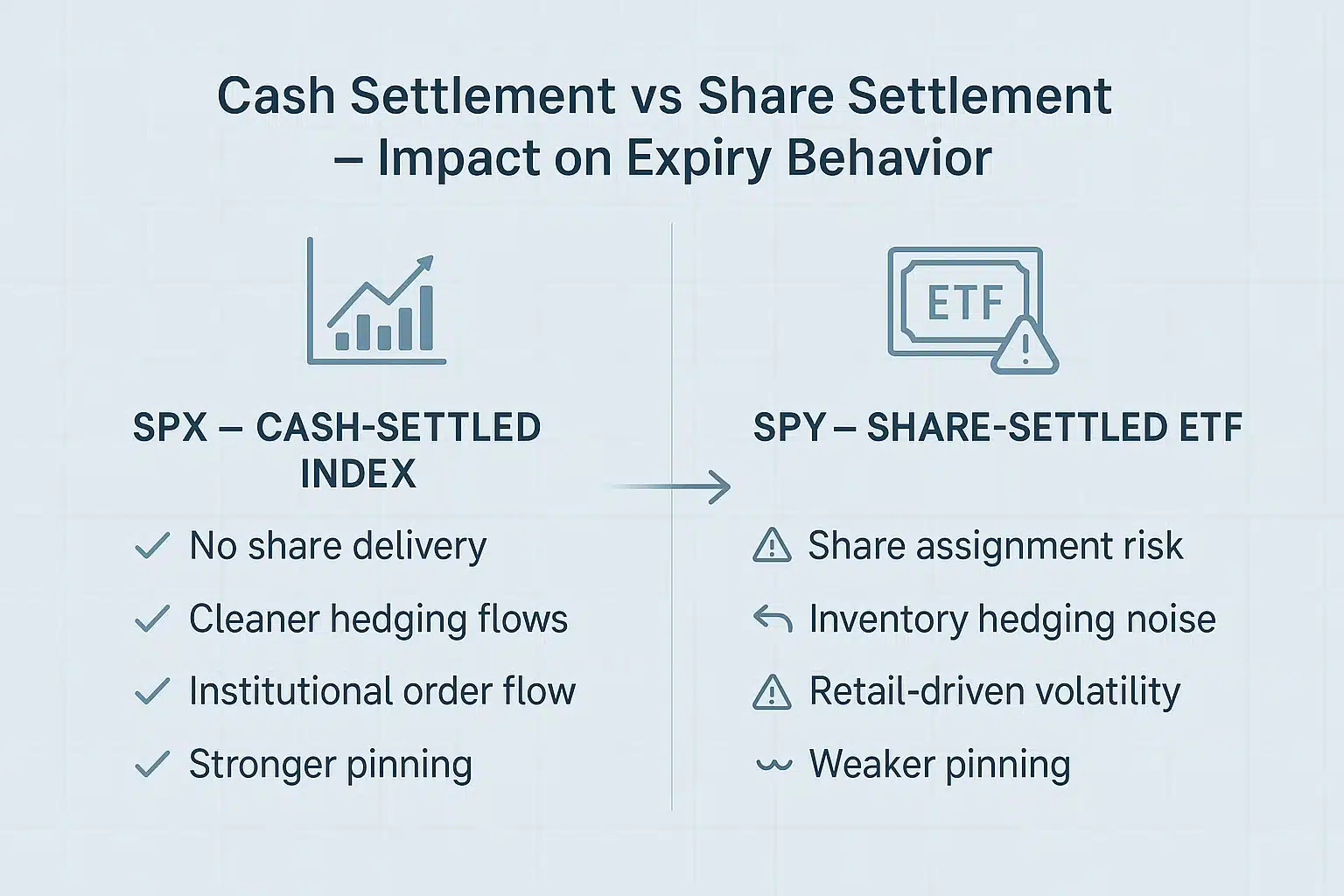
Cash Settlement vs Share Settlement — Impact on Expiry Behavior
Why Max Pain Behaves Differently on SPX
This is where the real divergence between SPX and SPY begins. Even though both track the S&P 500, their expiration mechanics produce completely different hedging flows.
After watching thousands of expirations over the years — both manually and through my automated systems — I can tell you that SPX behaves far more “orderly” into expiry.
1. Cash Settlement Creates Clean Expirations
SPX options settle in cash. That single feature removes the biggest source of expiration chaos: share delivery.
Market makers don’t have to worry about being assigned thousands of shares on a Friday afternoon — they simply settle the cash differences.
This leads to:
- far less assignment-driven volatility,
- no need to unwind large share positions late in the day,
- cleaner, more predictable hedging flows,
- and stronger alignment between options open interest and index behavior.
In practice, this is one reason SPX often “glides” toward heavy open-interest strikes when volatility is low. Market makers can hedge purely based on price risk, not inventory risk.
This cleaner expiration flow is also why SPX is the backbone of most of my automated credit-spread systems. If you want the full ruleset, I walk through it step-by-step in my guide on using max pain with credit spreads and iron condors.
2. Institutional Order Flow Dominates
SPX is an institutional product. Pension funds, insurance companies, volatility funds, structured-product desks — they all use SPX options as a core hedging tool.
Their flows are:
- large,
- methodical,
- and typically predictable.
When these players hedge near a specific strike cluster — often round numbers like 4500, 4600, or 4700 — the index can stabilize around those levels because dealers are adjusting deltas in controlled, systematic ways.
This institutional footprint is why, in calmer markets, you’ll see SPX pin so cleanly that it almost looks engineered. It isn’t — it’s just the natural effect of large hedgers adjusting exposure into expiration.
3. AM Settlement on Monthly Expirations
SPX monthly options settle based on the opening rotation on Friday morning — not the closing print. That changes the entire rhythm of expiration:
- hedging pressure peaks into Thursday’s close,
- dealers rebalance aggressively late Thursday afternoon,
- and the actual settlement price is determined by Friday’s opening auction.
This is one reason you sometimes see SPX behave more predictably the day before expiration than on expiration itself.
This Thursday effect shows up repeatedly in historical data as well. My 100-expiration research found that Wednesday and Thursday flows consistently create the cleanest pinning behavior, which is why many traders lean on mid-week automated SPX spreads instead of guessing intraday direction.
Most dealers want to be delta-neutral heading into the opening print, so Thursday’s price action often reflects max pain dynamics more cleanly than Friday’s first 15 minutes.
Why Max Pain Behaves Differently on SPY
SPY may track the same index, but it trades nothing like SPX around expiration. The ETF structure adds layers of noise that distort max pain levels — and I see this play out consistently across my intraday flow models.
SPY options are share-settled, which means assignment results in actual shares changing hands. Market makers must manage:
- inventory size,
- stock borrow availability,
- ETF creation/redemption baskets,
- and the risk of ending up massively long or short after the bell.
This forces dealers to constantly rebalance share positions, breaking the smooth delta/gamma hedging relationships you see on SPX. As a result, SPY price action tends to deviate from max pain levels more often.
2. Heavy Retail Flow Adds Noise
SPY is one of the most actively traded ETFs in the world — and much of that flow comes from retail traders, short-term scalpers, and intraday algorithmic strategies.
When retail traders chase moves or react to headlines, their order flow can easily overpower the subtle push toward max pain.
That’s why it’s common to see SPY trading several dollars away from its max pain level throughout the day, even when open interest suggests pinning should occur.
3. PM Settlement Increases Late-Day Volatility
Unlike SPX, all SPY options settle at the closing price. The final minutes of the session are often dominated by:
- ETF rebalancing,
- closing auction imbalances,
- end-of-day hedging and unwinding,
- and institutional equity flows unrelated to options.
Even if SPY drifts toward max pain midday, a late-day surge in ETF-related order flow can completely overpower the pinning effect.
This is exactly why SPY max pain should be viewed as a reference zone — not a precise magnet — for intraday traders.
If you want to see these SPY-specific behaviors in isolation, I break them down with real examples in my SPY Max Pain guide. SPY can still offer useful context, but its max pain levels must be treated as soft zones rather than precise magnets.
Pinning Strength Comparison: SPX vs SPY
Based on every expiration dataset I’ve analyzed over the years — and the live behavior I see inside my automated credit-spread systems — the conclusion is simple:
SPX pins more cleanly and more consistently than SPY.
Here’s why:
- SPX is cash-settled → no share-delivery distortions
- Dealer hedging is cleaner and more predictable
- Institutional flows dominate the order book
- Open interest clusters often sit on round numbers (strong psychological magnets)
- AM-settled monthly expirations reduce closing-auction volatility
SPY, by comparison, behaves like any heavily traded stock: noisy, reactive, and influenced by ETF mechanics. Max pain can still matter, but the “gravitational pull” is far weaker.
These differences also line up with the raw expiration data from my 100-SPX-expiration analysis, where SPX pinned within ±1% almost half the time, while SPY lagged far behind.
Quick Example: SPX Pins, SPY Overshoots
SPX example:
- Max pain: 4600
- Afternoon price: 4614
- Dealers hedge short-call exposure → selling pushes price lower
- SPX closes: 4603.7
Classic, clean SPX pin.
SPY example:
- Max pain: 460
- Afternoon price: 463.50
- ETF flows + retail momentum push price around
- SPY closes: 462.8
Max pain visible, but nowhere near a precise pin.
This difference is exactly why expiration-driven strategies, including defined-risk credit spreads, tend to use SPX as the primary reference point — and why SPY is better for intraday context, not precise expiration targeting.
How Automated Trading Handles SPX vs SPY Max Pain
When you run automated systems — especially ones built around weekly credit spreads like mine — you quickly see how differently SPX and SPY respond to max pain dynamics.
The most important distinction is this:
SPX max pain behaves like a structural force, while SPY max pain behaves like a sentiment zone.
My automated engines treat the two products very differently because their market microstructure is nothing alike. SPX flows are slower, heavier, and institution-driven. SPY flows are more reactive and often dominated by retail and ETF arbitrage.
This is also why almost all of my systematic credit-spread engines use SPX as the base product. If you want to replicate the exact filters I use (volatility regime, distance from max pain, and OI clusters), you can see the full flow in my Automated Options Trading Guide.
How Automated Systems Interpret SPX
SPX is ideal for systematic trading because the flows driving it are consistent. Dealer hedging is orderly, and open interest tends to cluster tightly around round numbers — creating natural magnets during calm market conditions.
For automation, this leads to clear advantages:
- Cleaner hedging flows → easier modeling of expiry drift
- More predictable gamma behavior → tighter risk modeling
- Institutional order flow → less random noise
- Better alignment with max pain → stronger expiration pinning
This is why most of my defined-risk weekly strategies — including the credit spreads sent through Weekly Trend and Weekly Premium — are based on SPX. It’s simply more compatible with rule-based execution.
How Automated Systems Interpret SPY
SPY is too noisy to treat max pain as a primary driver. Retail orders, ETF creation/redemption, and intraday flows distort the clean mechanics you see in SPX.
Automated systems must adjust for:
- Intraday volume spikes that overpower hedging flows
- Retail-driven volatility around headlines
- Share-delivery hedging that breaks pinning behavior
- PM-settlement volatility near the closing auction
Because of this, SPY max pain is used in my systems as a secondary confirmation tool, not as a predictive anchor. It helps indicate zones of interest — not exact expiration magnets.
When Traders Should Use SPX Max Pain
Not all max pain signals are created equal. In my experience — both manual and automated — SPX max pain is most useful when you’re trading defined-risk spread strategies into expiration, especially in calmer markets.
You should lean on SPX max pain when:
- You trade SPX credit spreads (bull put spreads, bear call spreads, iron condors)
- You want reliable institutional signals on expiry days
- Volatility is low and market conditions are stable
- You’re looking for a clean, predictable expiration drift
- You want to model dealer hedging flows directly
If you trade defined-risk SPX spreads, this is where max pain becomes a genuine advantage. You can see how I apply these conditions to real spreads in my walkthrough on using max pain with credit spreads and iron condors.
These are the exact conditions where max pain can act like a gravitational pull — not always, but often enough to matter. If you’ve ever watched SPX chop around a round number for hours on a Thursday afternoon, you’ve seen this in action.
This is also why most institutional traders and structured-product desks rely on SPX for weekly hedging. The product behaves consistently, and max pain interacts with hedging flows in a way that’s measurable and repeatable.
When Traders Should Use SPY Max Pain
SPY has its place — it’s just not the same place as SPX.
SPY max pain is more useful for intraday context, retail-flow insight, and identifying broad pressure zones rather than exact pinning targets.
SPY max pain is helpful when:
- You trade SPY directly (shares or options)
- You want to identify short-term support/resistance levels
- You track retail-driven momentum or headline reactions
- You’re scalping or day trading short-term moves
- You need a “zone of interest,” not a precise expiration target
SPY is a hyper-liquid trading vehicle. It behaves more like an equity than an index, which means max pain gets diluted by retail traders, ETF flows, and end-of-day auction imbalances.
It’s still useful — but as a broad guide, not as a precise magnet like SPX.
For this reason, in my systems SPY serves as a secondary signal, especially when SPX and SPY max pain cluster around the same levels. When both instruments show alignment, the probability of the market respecting those zones increases.
For most traders, SPY max pain is best used as a secondary filter — a way to sense retail-driven magnet zones rather than a precise expiry target. You can see detailed SPY expiration examples in my SPY Max Pain guide.
Summary Table: SPX vs SPY Max Pain
| Feature | SPX | SPY |
|---|---|---|
| Settlement | Cash | Shares |
| Who Trades It | Institutions | Retail + ETFs |
| Pinning Strength | Strong | Weak–Medium |
| Best Use Case | Credit spreads | Intraday context |
| Expiration Drift | Predictable | Noisy |
Final Verdict: SPX vs SPY Max Pain
After watching thousands of expirations over the years — and building automated strategies around both products — the conclusion is clear:
SPX max pain is more reliable, more consistent, and far more actionable than SPY max pain.
SPX’s cash settlement, institutional participation, round-number clustering, and predictable hedging flows all work together to create cleaner expiration behavior. When volatility is low, SPX often behaves as though it’s “magnetized” toward heavy open-interest levels.
SPY, by contrast, is influenced by ETF mechanics, retail flows, and the chaotic nature of PM settlement. Max pain still matters for SPY — but mostly as a zone of interest, not a precise expiration magnet. It’s excellent for intraday context, but not for pinpointing where the market is likely to settle.
If max pain is part of your trading playbook — especially for defined-risk weekly credit spreads — then SPX should be your primary guide.
That’s exactly why my automated systems prioritize SPX signals: the behavior is more consistent, the hedging flows are easier to model, and the pinning effect shows up more often.
If you want to see how I apply SPX max pain in live weekly trading — with fully automated SPX iron condors and credit spreads — my Weekly Premium service sends the exact trades I take each week. It’s designed for traders who want defined-risk, rules-based SPX strategies without needing to monitor the market all day.
FAQs
1. Is SPX max pain more accurate than SPY max pain?
Yes — in my experience, SPX tends to pin more cleanly due to cash settlement, lower noise, and stronger institutional hedging flows. SPY behaves more like a stock with frequent intraday volatility and ETF-driven moves.
2. Can SPY max pain still be useful?
Absolutely. SPY max pain can be helpful for identifying zones of interest, retail sentiment, and short-term support/resistance. It’s just rarely a precise expiration magnet.
3. Does max pain always influence price movement?
No. Max pain is a guide, not a rule. Strong news, macro events, or volatility spikes can easily overpower hedging flows. Max pain tends to work best in calm or moderately quiet markets.
4. Is max pain a good standalone trading strategy?
Not by itself. Max pain becomes valuable when you combine it with other factors like volatility conditions, dealer gamma levels, and liquidity flows. It’s a useful reference tool — not a complete trading system.
5. Is it better to trade SPX or SPY options?
It depends on your goals, account size, and how you manage risk — but for expiration-based spread strategies, SPX is generally better for most professional and automated traders.
SPX advantages:
Cash-settled, so no share assignment or pin risk
Cleaner hedging flows means more predictable expiry behaviour
Stronger and more reliable max pain dynamics
Better for defined-risk strategies like credit spreads and iron condors
SPY advantages:
Smaller contract size is better for small accounts
Extremely liquid for intraday or directional trades
More flexible for trading shares and options together
If you’re trading expiry-driven credit spreads, SPX tends to offer a more consistent edge. If you’re day trading or scalping, SPY may be more suitable.
6. What are the pros and cons of SPX?
Pros (why pros prefer it):
Cash settlement eliminates share delivery and overnight assignment risk
Cleaner max pain behaviour due to institutional order flow
More predictable expiration drift, useful for spreads
Tax advantage for US traders (60/40 treatment under Section 1256)
Large notional exposure, so fewer contracts needed
Cons:
Larger contract size → higher buying-power requirement
Wider bid–ask spreads than SPY (though still very liquid)
Not ideal for very small accounts
Less flexible for hedging with shares
For traders running defined-risk weekly strategies, the pros outweigh the cons.
7. Is SPX or SPY more liquid?
SPY is more liquid in absolute terms, especially intraday — huge volume, tight penny spreads, and constant ETF trading flows.
But SPX has deeper institutional liquidity, especially around major strikes and near expiration. This creates:
more stable hedging flows,
cleaner gamma effects,
stronger pinning behaviour.
So:
SPY is more liquid for trading in and out during the day.
SPX is more liquid where it matters for credit spreads — at the strikes.
Both are highly liquid, but used for different purposes.
8. Is there pin risk on SPX?
No, not in the traditional sense.
SPX options are cash-settled, so you never wake up long or short shares after expiration. There is no risk of assignment leading to an unwanted stock position.
However, there is pricing pin risk, meaning SPX can gravitate toward heavily traded strikes near expiration, influenced by dealer hedging flows. This is useful for spread traders, not harmful.
SPY, on the other hand, does have true pin risk because options settle into actual shares.
9. Should I use max pain for credit spreads?
Yes, especially on SPX. When open interest, hedging flows, and volatility align, max pain levels can help you structure safer, more favorable credit spreads. This is a core component of how I build the automated SPX strategies inside Weekly Trend and my Weekly Premium service.
Max Pain: Complete Learning Path