Credit spreads and debit spreads are two of the most widely used defined-risk options strategies, but they behave very differently once real money is on the line.
One collects premium and benefits from time decay. The other pays premium and relies on price movement. Confusing the two is one of the fastest ways new traders stack the odds against themselves.
In this guide, we’ll break down credit spreads vs debit spreads in practical terms: how they make money, when each works best, and how volatility, theta, and probability shape the outcome.
You’ll see real SPX and SPY examples, clear payoff math, and a side-by-side comparison to help you choose the right tool for the right market environment.
By the end, you’ll know exactly when to sell premium, when to buy it ,and why defined risk matters more than prediction.
Short version: a credit spread sells premium first and profits when price doesn’t move much, while a debit spread pays premium up front and profits from a directional move. Both are defined-risk strategies used by SPX and SPY traders every day.🎧 Podcast: Credit Spread vs Debit Spread — Key Takeaways
Prefer to listen? Here’s the episode that walks through the same concepts with real SPX/SPY examples.Key takeaways
- Cash flow: Credit spread = receive premium; Debit spread = pay premium.
- Market view: Credit for neutral/slow markets; Debit for stronger trends.
- Risk: Both are defined-risk; you know max loss before entry.
- Greeks: Credit spreads benefit from theta and often short vega; debit spreads need movement (delta) and can benefit from long vega.
What Is a Credit Spread?
A credit spread is built by selling an option and buying another option of the same type (call or put) with a further strike, same expiration. You receive a net credit up front, and your risk is capped by the long option. New to spreads? Start with our pillar primer: What Is a Credit Spread?When to use a credit spread
- Neutral to mildly directional outlook (e.g., expect price to stay below/above a level).
- Elevated IV where option premiums are richer.
- When you want time decay (theta) working for you.
Payoff math (at expiration)
- Max profit: the credit received.
- Max loss: strike width − credit received.
- Breakeven: for a bull put = short put strike − credit; for a bear call = short call strike + credit.
Example: SPX Bull Put Credit Spread
Sell 5000 put / Buy 4995 put for a $2.50 net credit. Width = 5 → Max loss = 5 − 2.50 = $2.50 per share ($250 per contract). Breakeven = 5000 − 2.50 = 4997.50. Profit if SPX stays above the short strike at expiration. For deeper risk handling (assignment, early exits, margin), see Risks of Credit Spreads: What You Can Lose & How to Manage It.What Is a Debit Spread?
A debit spread is built by buying an option and selling another option of the same type with a closer strike, same expiration. You pay a net debit up front and pursue a directional move to realize profit.When to use a debit spread
- Stronger directional outlook (bullish for calls, bearish for puts).
- Lower IV environments where options are cheaper.
- When you prefer defined risk with a smaller capital outlay than a naked long option.
Payoff math (at expiration)
- Max loss: the debit paid.
- Max profit: strike width − debit paid.
- Breakeven: for a bull call = long call strike + debit; for a bear put = long put strike − debit.
Example: SPY Bull Call Debit Spread
Buy 500 call / Sell 501 call for a $0.50 net debit. Width = 1 → Max profit = 1 − 0.50 = $0.50 per share ($50 per contract). Breakeven = 500 + 0.50 = 500.50. Profit if SPY trends higher toward the short call.Credit Spread vs Debit Spread: Key Differences
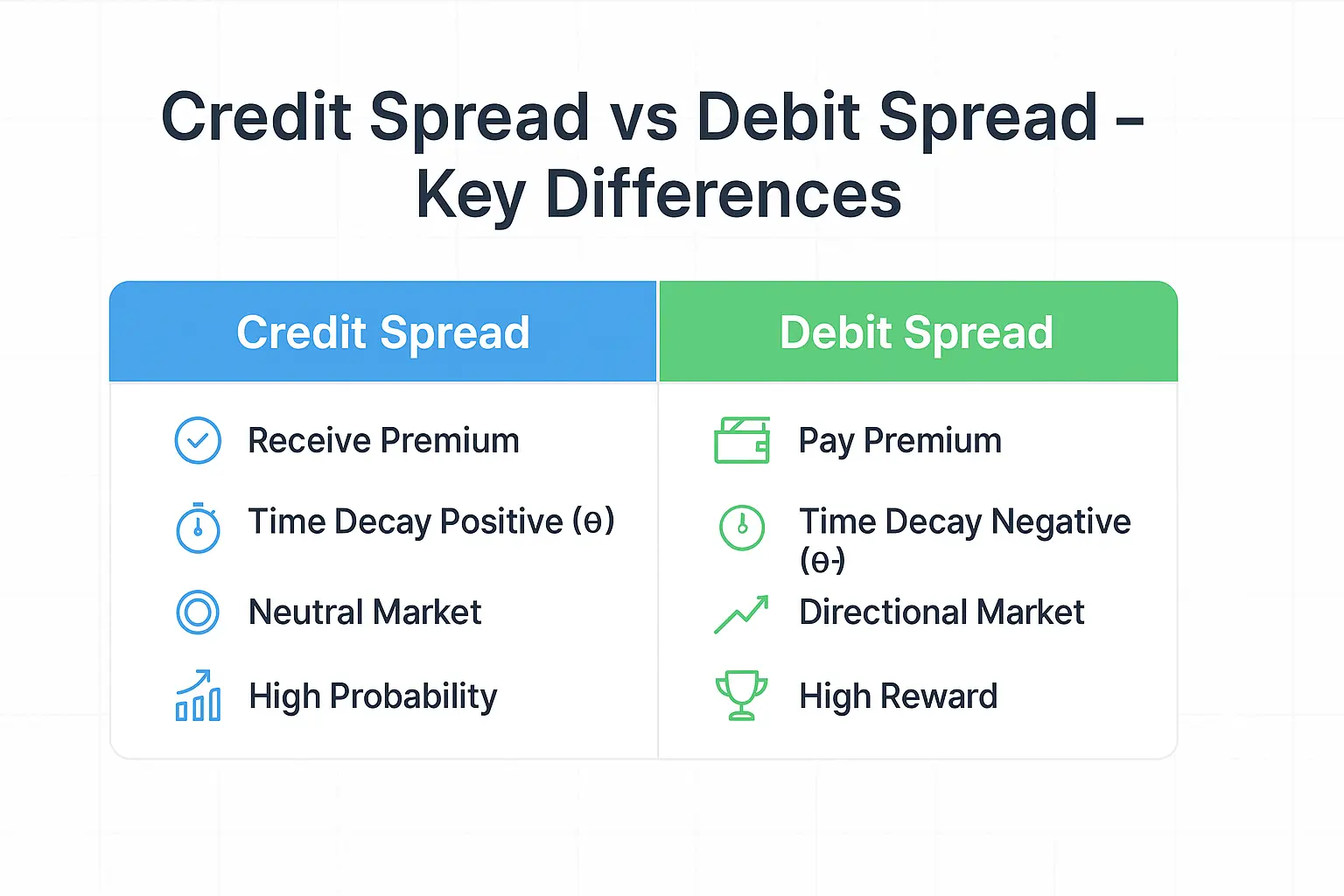
Although both are defined-risk options strategies, credit and debit spreads behave very differently. Credit spreads collect premium and thrive on stability, while debit spreads pay premium and need movement.| Feature | Credit Spread | Debit Spread |
|---|---|---|
| Cash Flow | Receive net credit (collect premium up front) | Pay net debit (premium paid to enter) |
| Market Outlook | Neutral to mildly directional | Bullish (call spread) or bearish (put spread) |
| Max Profit | The credit received | Width − debit paid |
| Max Loss | Width − credit received | Debit paid |
| Theta (Time Decay) | Positive (benefits from time passing) | Negative (loses value over time) |
| Implied Volatility (IV) | Best in higher IV environments | Best in lower IV environments |
Pros and Cons of Credit vs Debit Spreads
Both spreads have unique advantages depending on your market outlook, volatility, and personality as a trader. Here’s how I think about them after 20+ years trading SPX and SPY options.Credit Spread Pros
- Defined risk and defined reward.
- Earn from time decay (theta).
- Higher probability of profit (POP 55–75%).
- Can be automated for consistent income.
Credit Spread Cons
- Smaller profit potential vs. risk.
- Vulnerable to volatility spikes and gaps.
- Need margin for collateral (especially in larger accounts).
Debit Spread Pros
- Limited risk — can’t lose more than premium paid.
- Cheaper alternative to buying naked options.
- Ideal when expecting clear directional momentum.
Debit Spread Cons
- Requires movement to profit (negative theta).
- Lower probability of profit than credit spreads.
- Can expire worthless if price stalls.
When to Use Credit vs Debit Spreads
Timing matters as much as direction. The decision between a credit or debit spread usually depends on volatility levels and market momentum.Use a Credit Spread When:
- Implied volatility is elevated, making premiums rich.
- You expect price to stay within a range or move slowly.
- You prefer a higher win rate with smaller, steadier returns.
Use a Debit Spread When:
- Implied volatility is low, and options are cheap.
- You expect a clear directional move (bullish or bearish).
- You’re okay with a lower win rate in exchange for larger potential reward.
In my SPX trading, I use credit spreads 80% of the time. When the VIX drops below 13 and volatility risk is minimal, I occasionally switch to debit spreads for short-term directional setups.Credit spreads fit better for defined-risk income traders who value probability over excitement. Debit spreads appeal to momentum traders chasing high reward-to-risk setups. See real SPX trade examples showing when to deploy bull put vs bear call spreads.
Common Mistakes When Trading Credit and Debit Spreads
Most beginners lose money not because the strategy is bad—but because they use it in the wrong market environment or ignore the math. Here are the traps I see most often in new SPX and SPY traders:- Placing spreads too close to the money: chasing extra credit increases risk of being tested or assigned.
- Holding to expiration: hoping for 100% profit exposes you to late-cycle gamma and assignment risk.
- Trading during major news events: Fed meetings and CPI can blow through your strikes overnight.
- Oversizing positions: defined risk ≠ small risk—respect your per-trade allocation (1–3% of account).
- Ignoring volatility: selling low-IV credit spreads or buying high-IV debit spreads flips the odds against you.
Remember: it’s not about being right—it’s about surviving long enough for probabilities to work in your favor.
FAQs: Credit vs Debit Spreads
1. Which is better, a credit spread or a debit spread?
Neither is universally better—it depends on your outlook. Credit spreads suit neutral or slow markets, while debit spreads are better when you expect strong movement.2. Is a credit spread safer than a debit spread?
Yes, in most cases. Credit spreads usually have a higher probability of profit and smaller but steadier gains. Debit spreads risk the full premium paid but can deliver higher returns when price moves quickly.3. Can I trade both credit and debit spreads on SPX?
Absolutely. Many professional traders alternate between them based on implied volatility. At Advanced AutoTrades, we also use credit spreads when IV is high and switch to debit spreads when volatility drops.4. How does theta affect these strategies?
Credit spreads benefit from time decay (positive theta). Debit spreads lose value over time unless price moves favorably (negative theta). For another angle, compare how credit spreads differ between bond markets and options — it’s a fascinating overlap between yield and risk premium.- Credit spreads sell premium and profit from stability and time decay.
- Debit spreads buy premium and require price movement to succeed.
- Both strategies have defined risk, but very different probabilities.
- Volatility environment often matters more than direction.
Conclusion: Trade Defined-Risk, Not Hope
At the end of the day, both credit and debit spreads give you a professional framework to control risk, define outcomes, and trade with confidence. The difference is whether you’re collecting premium (credit) or paying it (debit). If your goal is steady, probability-based returns, start with credit spreads. When markets get quiet and IV drops, use debit spreads for targeted directional plays. The key is matching the right tool to the right environment.FAQs
What is the difference between a credit spread and a debit spread?
A credit spread collects premium and profits if price stays within a range. A debit spread pays premium and profits only if price moves strongly in the expected direction.
How can I tell if a spread is debit or credit?
If you receive money when entering the trade, it’s a credit spread. If you pay money up front, it’s a debit spread.
Are credit spreads safer than debit spreads?
Generally, yes. Credit spreads tend to have a higher probability of profit, but smaller gains. Debit spreads risk less capital but require precise timing and movement.
What are the pros and cons of debit spreads?
Debit spreads cap risk and reduce cost versus naked options, but suffer from time decay and lower win rates if price stalls.
Can professionals trade both strategies?
Yes. Many traders switch between credit and debit spreads depending on implied volatility, trend strength, and event risk.