Have you ever noticed how SPX or SPY seems to drift toward a specific price level in the final hours of a Friday session, regardless of the morning’s trend?
This is max pain in action. Also known as the Maximum Pain Theory, this concept suggests that an underlying asset will gravitate toward the strike price where the greatest number of options (both calls and puts) will expire worthless.
For the option buyer, this is the point of “maximum financial agony.” For the option seller, typically large institutions and market makers, it is the point of maximum profit.
In 2026’s high-speed market, professionals don’t view Max Pain as a guarantee, but as a “probability magnet.” By identifying these levels, you can better structure your iron condors and credit spreads to sit safely outside the zone where dealers are most likely to pin the price.
Quick Answer
What is the max pain strategy?
The max pain strategy uses the max pain level — the strike price where the most options expire worthless — as a context filter for expiry-day trading. Rather than predicting price, traders use it to identify where dealer hedging pressure is likely to weaken and price may stabilise. It works best as a secondary input for defined-risk strategies like credit spreads and iron condors in low-volatility, event-free markets.
If you want to go deeper after this, I also break down the statistics in Does Max Pain Really Work? Data From 100 SPX Expirations and show my daily workflow in Max Pain Tracker: The Only 5 Things That Actually Matter Today.
What Is the Max Pain Strategy?
The max pain strategy — sometimes called the “options max pain theory” — says that the price of a stock or index often gravitates toward the strike where the greatest number of options (calls and puts) will expire worthless.
In plain English: it’s the level where most options buyers feel the “pain,” and option sellers (often market makers) keep the most premium.
So when you see price slowly drifting toward one key level on expiration Friday, it’s not always random. Often, you’re just seeing the max pain effect. That matters because it can help you frame potential price behavior near expiry — especially in SPX options and SPY ETFs, where liquidity and institutional flows are huge.
How Max Pain Is Calculated
The logic behind the calculation is simple, even if most traders now let tools do the heavy lifting. Max pain is based on open interest — the number of outstanding options contracts at each strike.
To find the max pain level for a given expiration, you:
- List all call and put open interest by strike.
- For each strike, estimate the payout if price expired there (how far ITM options would be, in dollars).
- Add up total option payouts for each strike.
The strike with the lowest combined payout is the max pain price — the level where the market would pay out the least to option holders and, in theory, where the underlying might settle.
How Max Pain is Calculated
You don’t need to be a math whiz, as modern tools do this in real-time, but here is the logic:
- Data Collection: Every outstanding option contract (Open Interest) is listed by strike.
- Intrinsic Value Check: For every possible closing price, the model calculates the “payout” dealers would owe option holders.
- The Minimum: The strike price that results in the lowest total payout from dealers to buyers is the Max Pain point.
Think of it as the market’s “Path of Least Resistance.”
SPX Max Pain Example: How It Works in Practice
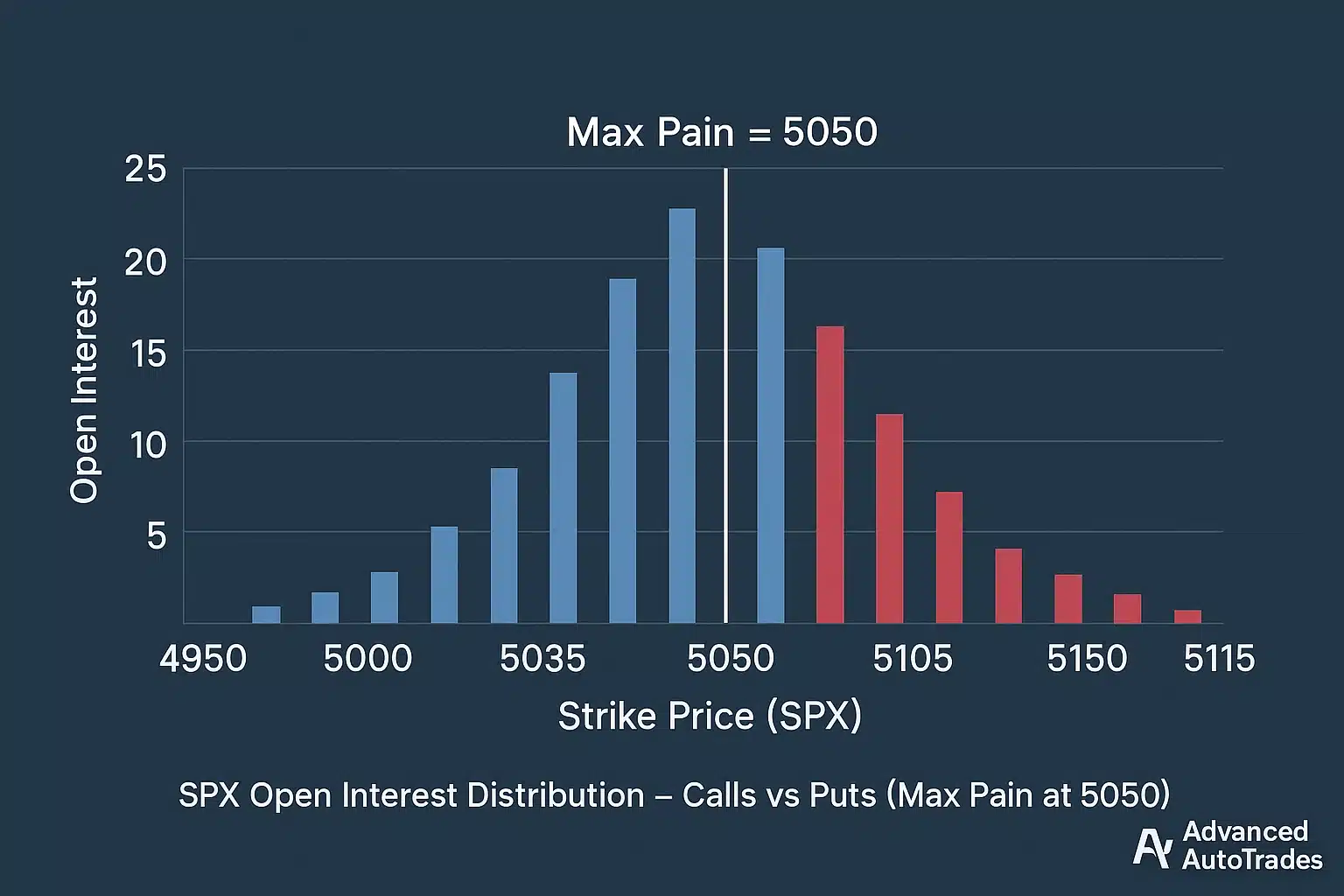
Suppose SPX is trading at 5050 on Thursday before expiry. The largest call open interest sits at 5100, and the largest put open interest sits at 5000. When you run the calculation, the model shows SPX max pain around 5050.
If the market gradually drifts back toward 5050 on Friday, that often isn’t coincidence. It’s a reflection of how market makers adjust hedges to minimize their exposure as time value burns off.
Explore today’s SPX levels:
SPX Max Pain Hub → Tools, Charts & Daily Levels
SPY Max Pain Example: Why It Often Matters on Expiry Friday
Now imagine SPY is trading at 510 before expiry. Most of the open interest is clustered between 508 and 512, and the SPY max pain level sits around 510.
If you watch the last hour of trading, you’ll often see SPY hover around that zone. That’s max pain in action — especially in quiet markets with no major macro news on deck.
SPY does behave differently from SPX, though. SPX is cash-settled and driven mainly by institutional desks; SPY is share-settled and heavily influenced by ETF flows and retail activity.
Get today’s SPY levels here:
SPY Max Pain Hub → Updated Levels & Charts
I go into those structural differences in more depth in SPX vs SPY Max Pain: Which Data Matters More For Pros? and in my SPY-focused breakdown SPY Max Pain: I Explain the Hidden Force Moving Markets.
Why Markets Gravitate Toward Max Pain
Market makers and liquidity providers sell a lot of options. To avoid directional risk, they hedge those positions by buying or selling the underlying. As expiration approaches and open interest shifts, they adjust those hedges. That hedging flow can naturally pull price toward the max pain level.
The more open interest built around a cluster of strikes, the stronger that gravitational pull tends to be — as long as volatility is low and there are no major headlines hitting the tape.
And that last part is critical: max pain is not always right. News, earnings, and macro events can easily overwhelm any pinning effect. Think of it as a tendency, not a guarantee — context, not prediction.
How to Use the Max Pain Strategy in an Options Expiry Setup
Here’s how I use max pain in practice.
Before Friday’s close, I’ll pull up an options max pain chart for the expiration I’m trading. I want to know where that “comfortable” zone is for dealers and how far price currently sits from it.
My basic playbook:
- If the market is well above max pain, I expect mild downside pressure in quiet conditions.
- If it’s well below, I expect a potential upward drift.
- If price is near max pain, I expect chop and consolidation.
This helps me frame my SPX and SPY expiry trades — especially when I’m building credit spreads or iron condors designed to benefit from sideways price action.
How Max Pain Fits With Defined-Risk Strategies
The max pain strategy pairs naturally with defined-risk setups like bull put spreads, credit spreads, and iron condors. These structures work best when price stays inside a controlled range — and that’s exactly what tends to happen when the market pins near max pain.
For example:
- SPX max pain: 5050
- Your iron condor: 4950/4970 puts and 5130/5150 calls
If SPX spends most of Friday oscillating around 5050, time decay is working for you, and both wings have room to breathe. You’re not relying on a huge directional call — you’re letting the market’s natural tendency to settle near max pain do some of the heavy lifting.
Automation makes this easier. At Advanced AutoTrades, we use rules-based systems to track open interest shifts, max pain levels, volatility, and trend — and then align our spread structures with that information.
In my Automated Options Trading Guide, I explain how max pain sits inside a broader, rules-based framework rather than acting as a standalone signal.
Max Pain Reliability: SPX vs SPY vs Single Stocks
| Feature / Factor | SPX (Index Options) | SPY (ETF Options) | Single Stocks (Equity Options) |
|---|---|---|---|
| Overall Reliability | High — most consistent | Moderate — reliable but noisier | Low — highly variable |
| Why | Cash-settled, deep liquidity, heavy institutional hedging | Share-settled, strong ETF flows, mixed retail/institutional activity | Fragmented open interest, event-driven volatility, unpredictable flows |
| Pinning Effect Strength | Strongest — clear clustering around key strikes | Moderate — visible on many Fridays but weaker than SPX | Weak — often overridden by earnings, catalysts, or low volume |
| Best Conditions | Low VIX, calm macro weeks, high OI concentration | Quiet weeks, end-of-day ETF rebalancing | Only when OI is extremely concentrated (rare) |
| Worst Conditions | CPI/FOMC weeks or trending markets | High volatility / intraday swings | Earnings season, low liquidity, stock-specific news |
| Typical Accuracy Range | Pins within 5–15 pts approx. 40–50% of quiet expirations | Pins within ±1–2 pts moderately often | Highly inconsistent, often no correlation |
| Why Pros Prefer It | Institutional flows make hedging behaviour predictable | Liquid, retail-friendly alternative to SPX | Too unreliable to use as a core signal |
| Best Use Case | Structuring SPX credit spreads or condors near expiry | Planning SPY expiry-day ranges | Background context only — not tradable alone |
Limitations and Best Practices
Used well, max pain can be a powerful context tool. Used blindly, it can lead you straight into trouble. A few guardrails I follow:
- Use it as a guide, not a trigger: Max pain should support your setup, not define it.
- Respect market context: High volatility, strong trends, or major macro news can completely overpower pinning effects.
- Be careful with 0DTE: Same-day options are brutal if you’re slow to adjust. Keep risk defined and sizes small.
- Combine with technicals: I care most when max pain lines up with support/resistance, volume shelves, or key moving averages.
- Update regularly: Open interest moves. Recheck levels as you get closer to expiration.
If you want a textbook overview first, Investopedia’s Max Pain Theory article is a good starting point. Then compare that to the real SPX data I share in my own work.
Final Thoughts
The max pain strategy gives you a clearer sense of where the market may “want” to settle as expiry approaches. It will never be perfect, but when you combine it with volatility, trend, and solid risk management, it can sharpen your expiry planning for SPX and SPY options.
If you’d rather have that logic built into a rules-based process, you can automate it. Our Weekly Premium SPX Signals use max pain as one of several filters when structuring defined-risk iron condors — so you’re not guessing where to place strikes week after week.
See how Weekly Premium automates SPX iron condors →
About the Author
Alexander Horn is Head of Automated Strategies at Advanced AutoTrades and has spent more than 15 years trading SPX and SPY options, both manually and through automation. He focuses on defined-risk credit spreads and iron condors built around real institutional positioning instead of retail myths.
Max Pain Strategy – Frequently Asked Questions
How do market makers use max pain?
Market makers don’t manually “aim” for max pain, but their hedging flows often create the effect.
When they sell options, they must hedge delta using the underlying (SPX, SPY). As expiration approaches and time value decays, their hedge requirements change. These adjustments can naturally pull price toward strikes with the largest open interest.
In other words:
Market makers don’t push price toward max pain intentionally — but hedging to stay neutral can make price behave like it’s magnetised to those levels.
This is why max pain works best on SPX and SPY, where institutional hedging dominates.
Is max pain a reliable indicator?
Max pain is not a reliable predictor of where price will settle, but it is a useful guide to where price may gravitate in calm, low-volatility environments.
Max pain is most reliable when:
There is a large cluster of open interest at nearby strikes
Volatility is low
No major macro events are scheduled
SPX/SPY are trading inside established ranges
It is least reliable when:
Volatility spikes
Strong trends are in play
Earnings, CPI, FOMC, or geopolitical headlines hit
Treat max pain as context, not a signal.
What is the point of max pain?
The purpose of the max pain level is to show where options sellers lose the least and options buyers lose the most at expiration.
This matters because:
It reveals where the “path of least resistance” may sit as expiry approaches
It highlights where hedging flows may compress price into a range
It gives traders a framework for building expiry-day spreads, condors, and credit spreads with better odds
It does not predict big moves — it helps frame lack of movement when the market is quiet.
How accurate is max pain historically?
Historically, max pain accuracy depends heavily on:
The underlying instrument (most accurate on SPX/SPY, least accurate on thin stocks)
Market volatility
The concentration of open interest
Based on my review of 100+ SPX expirations:
Max pain “pins” closely (~5–15 points) roughly 40–50% of the time in quiet markets
Accuracy drops sharply during VIX spikes or trend-driven weeks
Pinning is strongest around monthly SPX expirations and weakest on 0DTE cycles
Max pain is not a predictor — but it is highly useful for shaping expiry expectations, especially when paired with volatility, trend, and open-interest clustering.
Does max pain work better on SPX than on individual stocks?
In my experience, yes. SPX and SPY have deep liquidity and heavy institutional participation, which makes max pain more meaningful. On thinly traded single stocks with scattered open interest, the effect is usually too noisy to be useful.
How far away from max pain should my short strikes be?
There’s no single “right” distance, but I rarely place short strikes directly at the max pain level. I prefer to sit just outside the most crowded strikes so I can benefit from potential pinning without taking maximum heat if price overshoots.
Can I build a strategy that uses max pain automatically?
Yes. That’s essentially what I do in Weekly Premium. Max pain is one of several filters — alongside volatility, distance, and trend — that influence where we place SPX iron condors each week.
Where can I learn more about max pain with real examples?
For statistics, start with Does Max Pain Really Work? Data From 100 SPX Expirations. For a daily workflow, read Max Pain Tracker: The Only 5 Things That Actually Matter Today. Together they show how I use max pain in practice — not just as theory.
How do you use max pain to trade?
Max pain is used to frame expiry-day expectations rather than as a direct trade signal. Before expiration, identify the max pain level for your instrument. If price is well above it, mild downside drift is possible in calm conditions. If price is near it, expect consolidation. Use this context to position spread strikes safely outside the high open-interest cluster.
When is max pain most effective?
Max pain is most effective during the final one to two days before expiration, in low-volatility environments with no major economic events on the calendar. It works best on SPX and SPY when VIX is below 20 and price is already trading near a cluster of high open interest. Its effectiveness drops sharply during trend days, FOMC weeks, CPI releases, or any session with strong directional momentum.
What is the difference between max pain and support/resistance?
Max pain and support/resistance are both reference levels but they derive from different data. Support and resistance come from historical price action — prior highs, lows, and volume nodes. Max pain comes from options open interest — where the most contracts are positioned to expire worthless. The two can coincide, and when they do the level tends to be more significant. Max pain is expiration-specific and changes weekly; support and resistance are persistent structural levels.
Does max pain change during the day?
Yes , max pain changes continuously as new options positions are opened and closed throughout the session.
Most data providers update open interest once daily after the market close, so the max pain level you see during the trading day reflects the prior session’s positioning. Significant intraday options activity — particularly in the final hours before expiration — can shift the true max pain level meaningfully from what is displayed on most tools.
Max Pain: Complete Learning Path